Evaluation
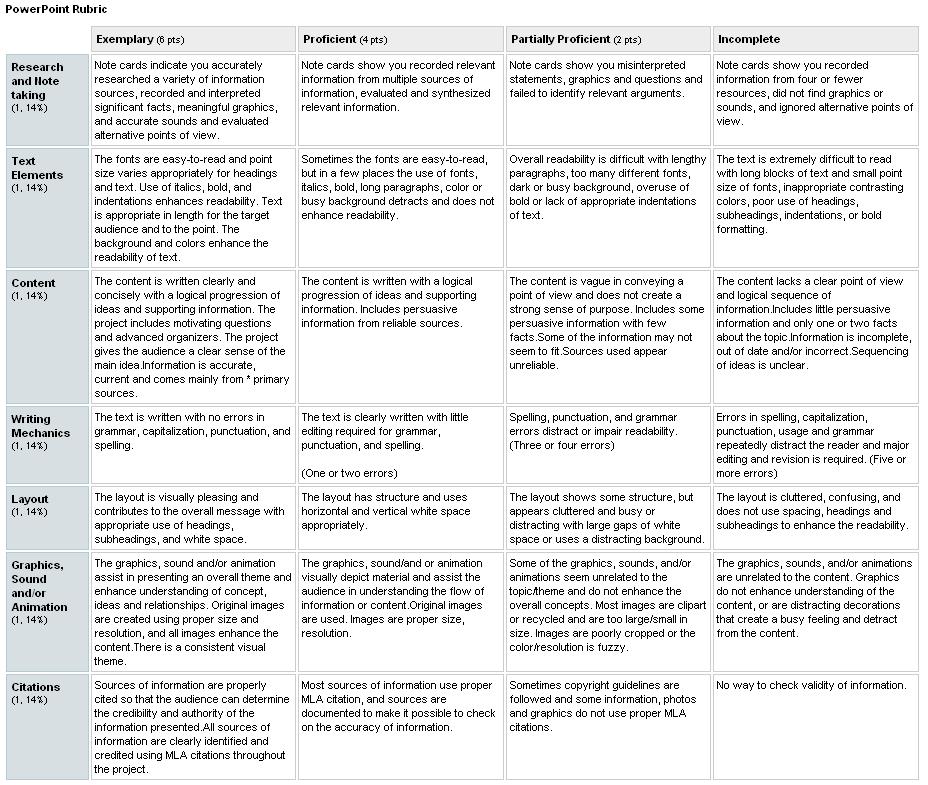
| Exemplary (6 pts) | Proficient (4 pts) | Partially Proficient (2 pts) | Incomplete | |
|---|---|---|---|---|
|
Research and Note taking
(1, 14%) |
Note cards indicate you accurately researched a variety of information sources, recorded and interpreted significant facts, meaningful graphics, and accurate sounds and evaluated alternative points of view. | Note cards show you recorded relevant information from multiple sources of information, evaluated and synthesized relevant information. | Note cards show you misinterpreted statements, graphics and questions and failed to identify relevant arguments. | Note cards show you recorded information from four or fewer resources, did not find graphics or sounds, and ignored alternative points of view. |
| Text Elements (1, 14%) | The fonts are easy-to-read and point size varies appropriately for headings and text. Use of italics, bold, and indentations enhances readability. Text is appropriate in length for the target audience and to the point. The background and colors enhance the readability of text. | Sometimes the fonts are easy-to-read, but in a few places the use of fonts, italics, bold, long paragraphs, color or busy background detracts and does not enhance readability. | Overall readability is difficult with lengthy paragraphs, too many different fonts, dark or busy background, overuse of bold or lack of appropriate indentations of text. | The text is extremely difficult to read with long blocks of text and small point size of fonts, inappropriate contrasting colors, poor use of headings, subheadings, indentations, or bold formatting. |
| Content (1, 14%) | The content is written clearly and concisely with a logical progression of ideas and supporting information. The project includes motivating questions and advanced organizers. The project gives the audience a clear sense of the main idea.Information is accurate, current and comes mainly from * primary sources. | The content is written with a logical progression of ideas and supporting information. Includes persuasive information from reliable sources. | The content is vague in conveying a point of view and does not create a strong sense of purpose. Includes some persuasive information with few facts.Some of the information may not seem to fit.Sources used appear unreliable. | The content lacks a clear point of view and logical sequence of information.Includes little persuasive information and only one or two facts about the topic.Information is incomplete, out of date and/or incorrect.Sequencing of ideas is unclear. |
| Writing Mechanics (1, 14%) | The text is written with no errors in grammar, capitalization, punctuation, and spelling. | The text is clearly written with little editing required for grammar, punctuation, and spelling.
(One or two errors) |
Spelling, punctuation, and grammar errors distract or impair readability. (Three or four errors) | Errors in spelling, capitalization, punctuation, usage and grammar repeatedly distract the reader and major editing and revision is required. (Five or more errors) |
| Layout (1, 14%) | The layout is visually pleasing and contributes to the overall message with appropriate use of headings, subheadings, and white space. | The layout has structure and uses horizontal and vertical white space appropriately. | The layout shows some structure, but appears cluttered and busy or distracting with large gaps of white space or uses a distracting background. | The layout is cluttered, confusing, and does not use spacing, headings and subheadings to enhance the readability. |
| Graphics, Sound and/or Animation (1, 14%) | The graphics, sound and/or animation assist in presenting an overall theme and enhance understanding of concept, ideas and relationships. Original images are created using proper size and resolution, and all images enhance the content.There is a consistent visual theme. | The graphics, sound/and or animation visually depict material and assist the audience in understanding the flow of information or content.Original images are used. Images are proper size, resolution. | Some of the graphics, sounds, and/or animations seem unrelated to the topic/theme and do not enhance the overall concepts. Most images are clipart or recycled and are too large/small in size. Images are poorly cropped or the color/resolution is fuzzy. | The graphics, sounds, and/or animations are unrelated to the content. Graphics do not enhance understanding of the content, or are distracting decorations that create a busy feeling and detract from the content. |
| Citations (1, 14%) | Sources of information are properly cited so that the audience can determine the credibility and authority of the information presented.All sources of information are clearly identified and credited using MLA citations throughout the project. | Most sources of information use proper MLA citation, and sources are documented to make it possible to check on the accuracy of information. | Sometimes copyright guidelines are followed and some information, photos and graphics do not use proper MLA citations. | No way to check validity of information. |
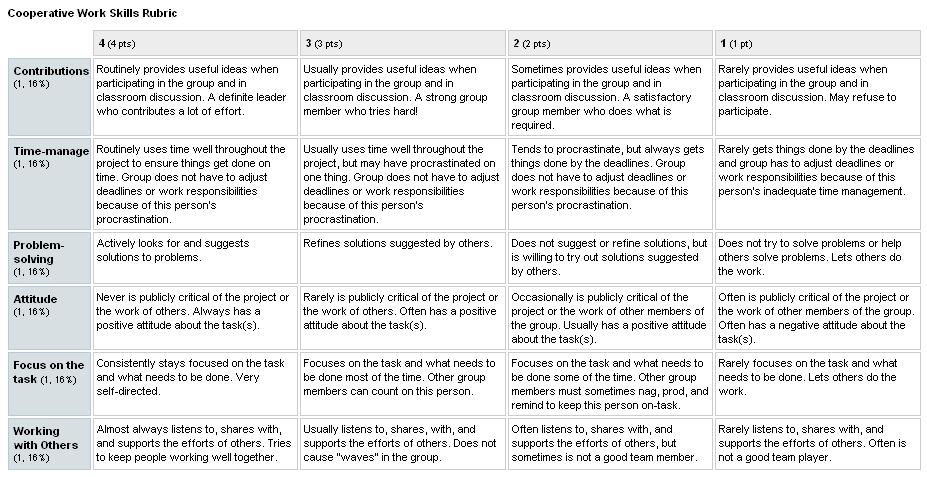
| 4 (4 pts) | 3 (3 pts) | 2 (2 pts) | 1 (1 pt) | |
|---|---|---|---|---|
|
Contributions
(1, 16%) |
Routinely provides useful ideas when participating in the group and in classroom discussion. A definite leader who contributes a lot of effort. | Usually provides useful ideas when participating in the group and in classroom discussion. A strong group member who tries hard! | Sometimes provides useful ideas when participating in the group and in classroom discussion. A satisfactory group member who does what is required. | Rarely provides useful ideas when participating in the group and in classroom discussion. May refuse to participate. |
| Time-management (1, 16%) | Routinely uses time well throughout the project to ensure things get done on time. Group does not have to adjust deadlines or work responsibilities because of this person's procrastination. | Usually uses time well throughout the project, but may have procrastinated on one thing. Group does not have to adjust deadlines or work responsibilities because of this person's procrastination. | Tends to procrastinate, but always gets things done by the deadlines. Group does not have to adjust deadlines or work responsibilities because of this person's procrastination. | Rarely gets things done by the deadlines and group has to adjust deadlines or work responsibilities because of this person's inadequate time management. |
| Problem-solving (1, 16%) | Actively looks for and suggests solutions to problems. | Refines solutions suggested by others. | Does not suggest or refine solutions, but is willing to try out solutions suggested by others. | Does not try to solve problems or help others solve problems. Lets others do the work. |
|
Attitude
(1, 16%) |
Never is publicly critical of the project or the work of others. Always has a positive attitude about the task(s). | Rarely is publicly critical of the project or the work of others. Often has a positive attitude about the task(s). | Occasionally is publicly critical of the project or the work of other members of the group. Usually has a positive attitude about the task(s). | Often is publicly critical of the project or the work of other members of the group. Often has a negative attitude about the task(s). |
| Focus on the task (1, 16%) | Consistently stays focused on the task and what needs to be done. Very self-directed. | Focuses on the task and what needs to be done most of the time. Other group members can count on this person. | Focuses on the task and what needs to be done some of the time. Other group members must sometimes nag, prod, and remind to keep this person on-task. | Rarely focuses on the task and what needs to be done. Lets others do the work. |
|
Working with Others (1, 16%) |
Almost always listens to, shares with, and supports the efforts of others. Tries to keep people working well together. | Usually listens to, shares, with, and supports the efforts of others. Does not cause "waves" in the group. | Often listens to, shares with, and supports the efforts of others, but sometimes is not a good team member. | Rarely listens to, shares with, and supports the efforts of others. Often is not a good team player. |
